

HOPE (Housing, People & Environment) was created to bridge research, policy, and practice around one central question: how do we design cities that support healthier lives equitably, measurably, and at scale. In the most recent edition of HOPE, that ambition translated into a concrete research-to-policy pathway through PABE and an international collaboration that brought Oman’s Healthy Cities into a globally comparable framework.
PABE: A research project that started at HOPE and moved into implementation
Our research project PABE (Physical Activity and the Built Environment) was introduced through the HOPE platform and accelerated during the last edition, where we focused on translating evidence into tools that decision-makers can actually use. HOPE 2024, in particular, emphasized sharing lessons from the implementation of PABE in Oman’s Healthy Cities including Muscat, Barka, and Nizwa and how evidence can guide healthier urban growth.
Across the project, the goal has been straightforward: understand how the built environment influences daily physical activity and identify practical planning and design levers that can strengthen walkability, access, safety, and well-being.
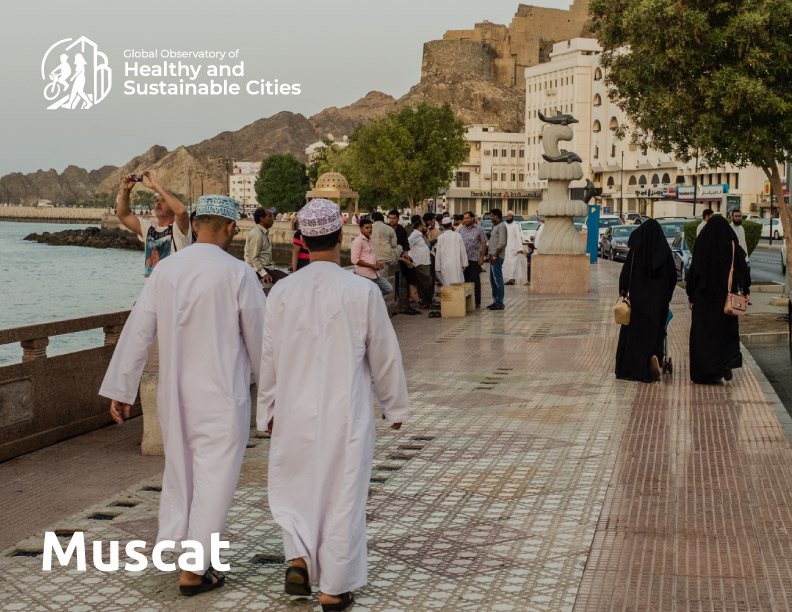
Collaboration with the Global Observatory: developing Healthy Cities policy scorecards
Building on the momentum created at HOPE, we collaborated with the Global Observatory of Healthy and Sustainable Cities (GOHSC) to support the development and use of Healthy Cities policy scorecards grounded in the Observatory’s indicator framework and the broader 1000 Cities Challenge approach to comparable, evidence-based measurement.
This work also aligns with published research assessing policy and regulatory documents across Muscat, Barka, and Nizwa using the Observatory’s policy checklist domains (e.g., integrated planning, walkability and destination access, public transport access, open space access, air quality/nature-based solutions, climate/disaster risk reduction).
International recognition: the GOHSC received the 2025 Nobel Sustainability Trust Award
GOHSC’s approach open science, comparable indicators, and city-ready tools has gained major international visibility. In October 2025, GOHSC announced it received the 2025 Nobel Sustainability Trust (NST) Sustainability Award for “Outstanding Research and Development for Intelligent and Sustainable Urban Solutions.” (This is a Nobel Sustainability Trust award, not a Nobel Prize from the Nobel Foundation.)
Download the publication
You can download the publication via the link below:
English Version: Muscat Healthy Sustainable Cities
Arabic Version: مسقط مدن صحية ومستدامة